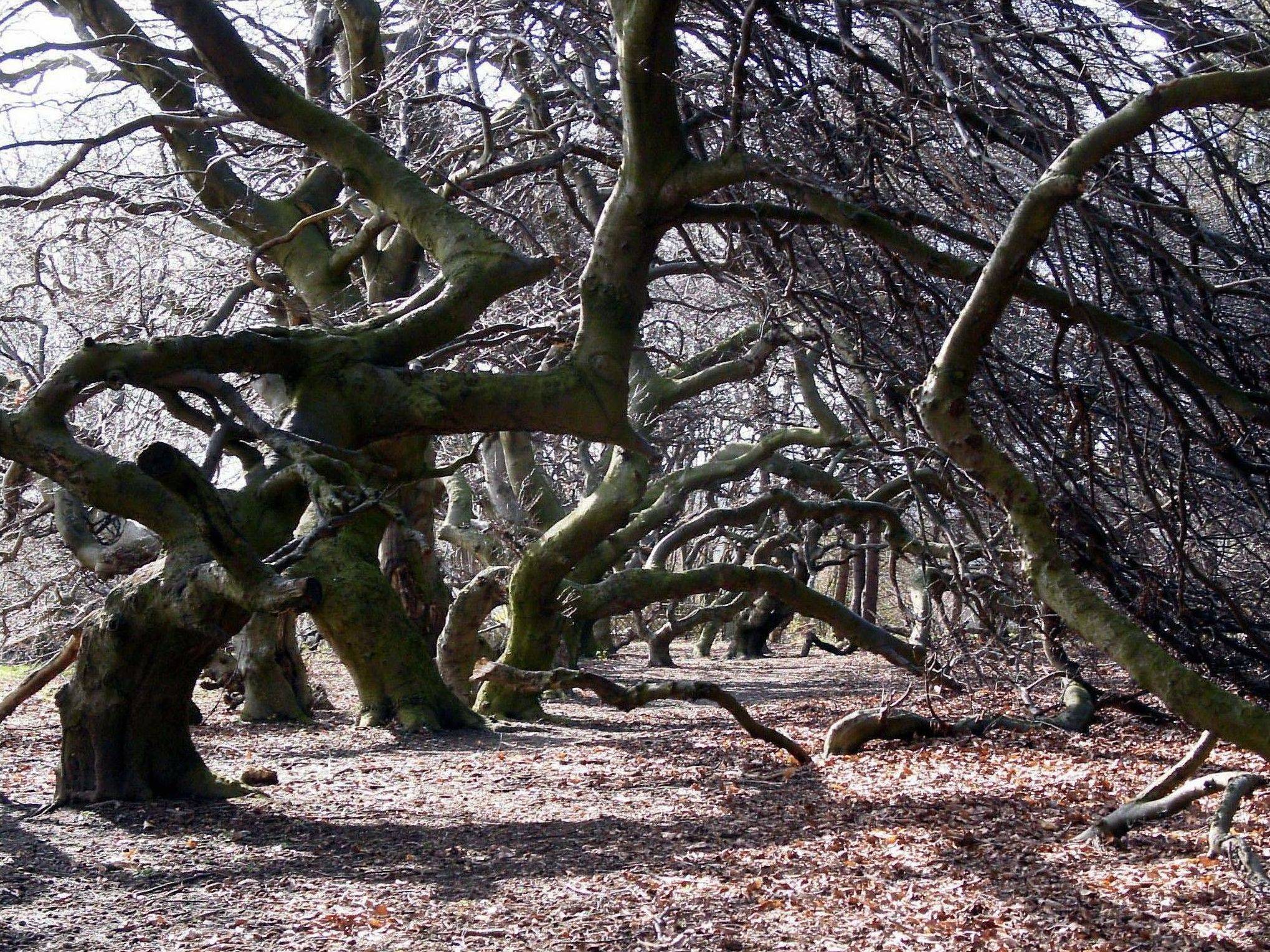
Dwarf beech avenue in Bad Nenndorf spa gardens in February 2003 · Tortuosa · Wikimedia Commons ↗ · CC BY-SA 3.0 ↗ · Cropped in cards; converted to WebP when imported locally
Twisted trunks and spreading canopies: discover Süntel beeches around Dachtelfeld, Raden, Bad Münder, Lauenau, Bad Nenndorf and Hannover.
Trees with a character of their own
The Süntel beech is a distinctive form of European beech, botanically Fagus sylvatica ‘Tortuosa’, also known in English as dwarf beech. Instead of a straight trunk, it develops twisted, curved and often widely spreading branches. Beneath the canopy, the space can feel like a living vault.
Bad Nenndorf: the beech avenue
The spa gardens in Bad Nenndorf offer a striking example of this growth form. The historic trees stand close together, their branches forming an interwoven structure. Walking slowly leaves time to notice the different shapes. Paths and barriers protect the sensitive area.
Hannover: the beech in the Berggarten
An impressive Süntel beech also grows in the Berggarten in Herrenhausen. Its spreading branches and additional stems show how much space such a tree can occupy. The photographs show two places where the trees’ distinctive features are easy to appreciate.
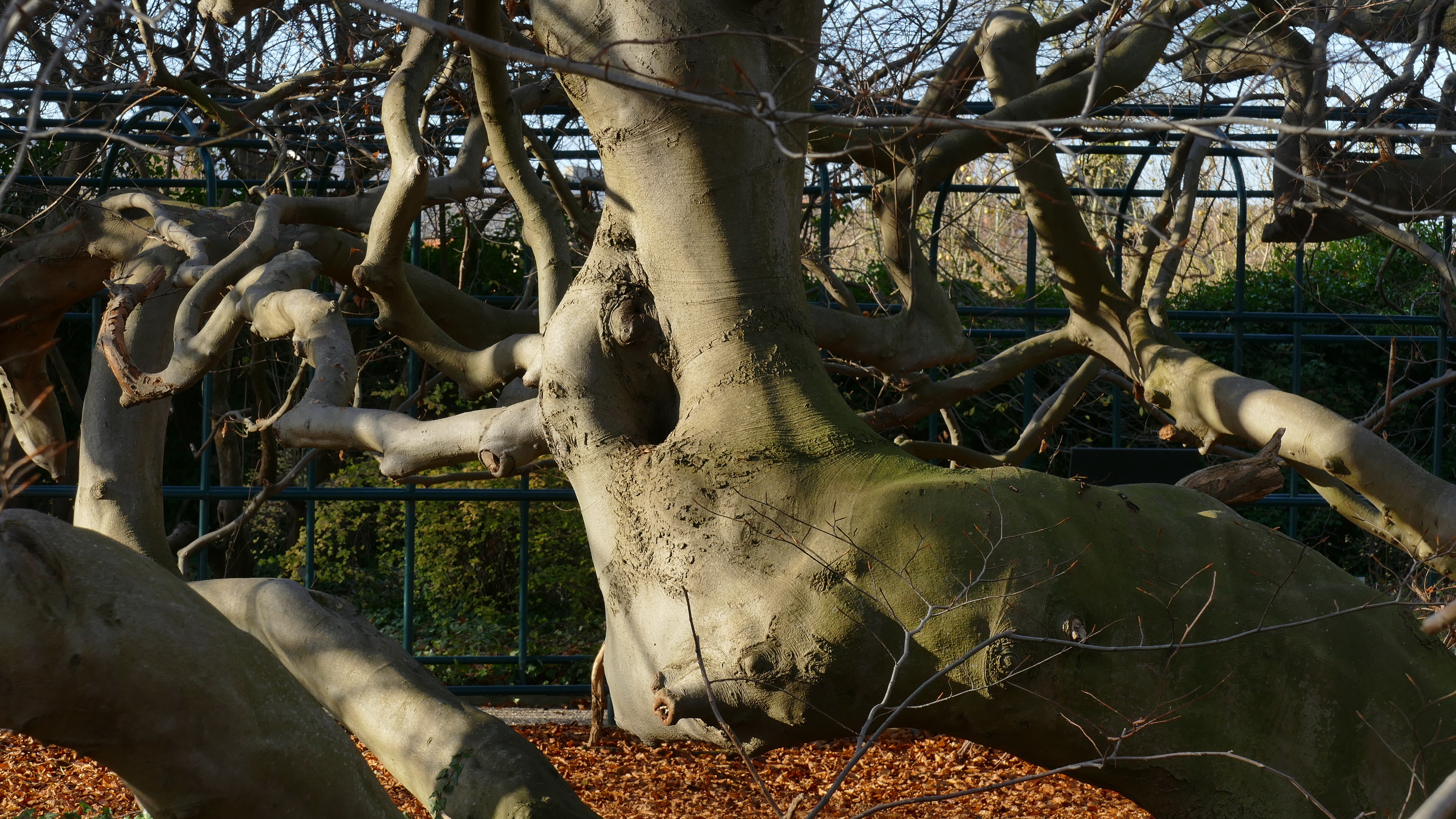
Spreading branches of the dwarf beech in Hannover’s Berggarten · Puusterke · Wikimedia Commons ↗ · CC BY-SA 4.0 ↗ · Cropped in cards; converted to WebP when imported locally
Where to find Süntel beeches
A regional guide to documented locations in the Süntel, Deister and surrounding area. Old trees can die or collapse; historic sites are identified separately. Check access locally, especially on private land.
- Dachtelfeld / Raden: Woodland beeches and younger plantings. Raden’s Tillybuche collapsed in 1994; its location is a historic site.
- Süntel / Deister: Forst Nienfeld, Hülsede, Feggendorf, Köllnischfeld.
- Bad Nenndorf: Beech avenue in the Kurpark.
- Bad Münder / Nettelrede: Arboretum Am Steinriepen; visits by arrangement. The local discovery route is listed below.
- Lauenau: Wasserburg; historic Volkspark site: the old monumental beech fell in August 2024.
- Further locations: Luttringhausen, Apelern, Haste, Lenthe, Schlosspark Schwöbber.
- Hannover: Berggarten in Herrenhausen.
- Wiehengebirge: Krause Buche, Eidinghauser Berg.
Bad Münder: the 15 stations of the discovery route
- Teufelsbuche · Steinhof
- Salinenbuche · Kurpark
- Gespensterbuchen · Kurpark
- Lange-Buchen · Kurpark
- Ziegenbuche · Bad Münder
- Steinkreuzbuche · Steinkreuzer Weg
- Gänsebuche · Hof Priesett
- Beekebuchen · Alter Teich / Bredenbeeke
- Melkerbuchen · Melkerweg
- Okerbuche · Süntelstraße
- Pfarrbuche · Beber
- Martinsbuchen · Eimbeckhausen
- Bruchbuche · Klein Süntel
- Kuhn-Buchen · Hamelspringe
- Kinderbuche · Nienstedt
Tree names are retained in German to match local signs. This is a regional overview, not a complete worldwide tree register.
Sources and route details: Freundeskreis Süntel-Buchen ↗ · Erlebnisroute ↗ · Raden / Tillybuche ↗ · Volkspark Lauenau ↗
Wolfgang Seifert and his nursery
Through his Kleine Süntelbuchen-Baumschule, Wolfgang Seifert works to propagate and preserve this rare growth form. He grows the trees from seed. The Schaumburger Landschaft recognised his work with a special award in 2026.
Mr Seifert does not have his own website. Read more about his work:
Official profile: Wolfgang Seifert’s Süntel beech nursery (German) ↗